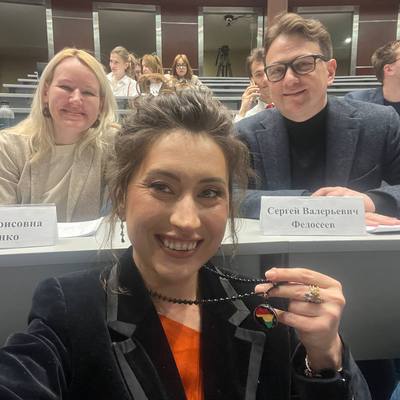
At the Moscow State Institute of International Relations of the Ministry of Foreign Affairs of Russia (MGIMO), the II Inter-University Championship on Russian international transport corridors was held. 64 students from 10 higher education institutions defended projects on the creation of Russian transport and logistics hubs in Africa. The concept of the championship was named “Hub Russia – Africa: assembly point”.
“What does Russia need? Fair logistics, as President of Russia Vladimir Putin said, and independent land and maritime transport corridors through which BRICS+ countries will be able to ensure the operation of supply chains for critical products for sustainable development. […] The task of the championship is to demonstrate different approaches in key African countries for the creation of a Russian hub, to showcase skills in creating an ecosystem between the state and business, and to receive feedback from business and governmental bodies on the presented approaches,” emphasised the head of the championship, Candidate of Political Sciences, and author of the concept of digital and civilisational corridors, Olga Podberezkina.
A member of the jury, Director of the Project Office for Support of Perspective Development Projects of VEB.RF, Denis Sinitsyn, in a conversation with TV BRICS, drew attention to the transport accessibility of Central and West African countries, including those that are strategic partners of Russia.
“Logistics is, in a sense, the artery of the economy’s circulatory system, and without resolving the issues that will be discussed today by colleagues from MGIMO, it is practically impossible to substantively develop supply projects, whether for exports to these countries, imports into the Russian Federation, or investment projects implemented by Russian economic operators in African countries,” explained Sinitsyn.
Photo: Nadezhda Zhuravleva
Director for Export Sales at Sinara – Transport Machines Ramazan Rakhmatov, in an exclusive comment to TV BRICS, specified the requirements for the architecture of the future hub. According to him, African markets need more than a simple port or logistics node.
“Africa needs not just a port or hub but a comprehensive solution: warehousing infrastructure with refrigeration equipment, independent energy supply, and the training of local personnel. This will help to compensate for systemic limitations in the region,” stated Rakhmatov.
He also emphasised the role of such projects in the development of a multipolar world order and cooperation within the BRICS group. “Hubs provide business with alternative routes, reducing dependence on traditional logistics nodes. The use of national currencies in settlements within BRICS+ decreases currency risks and makes cooperation more sustainable. […] BRICS+ countries control a significant share of global markets for grain, fertilisers, and metals, and unifying these flows through a single network of ports will create economies of scale,” noted Rakhmatov, adding that the hub should be bidirectional: the return load from Africa must ensure the economic feasibility of the project.
The TV BRICS International Media Network provides informational support to youth initiatives aimed at strengthening international cooperation, developing and expanding a network of partner universities in BRICS+ countries. As part of the partnership with MGIMO, the media network regularly prepares and publishes materials dedicated to student projects on global topics. This collaboration was highlighted at the opening of the championship on Russian international transport corridors by TV BRICS Executive Producer Kristina Muravyova.
Photo: Nadezhda Zhuravleva
The jury included Deputy Head for Research at the Department of Innovation Economics of the Faculty of Economics at Lomonosov Moscow State University, Candidate of Economic Sciences Elena Tishchenko; Managing Director for Strategic Projects at Sk Capital Sergey Fedoseev; Vice-Director of the International Cooperation Department of the Ministry of Energy of Russia Dmitry Poduev; as well as representatives of VEB.RF and political technologists. Participants of the championship included students of MGIMO, Saint Petersburg State University (SPbU), RANEPA, RUT (MIIT), RSUH, MAI, Plekhanov Russian University of Economics (REU), Vologda State University, Financial University under the Government of the Russian Federation, and others.
Text copied from https://tvbrics.com/en/news/russian-students-develop-projects-for-russian-transport-and-logistics-hubs-in-africa/
Photo: Nadezhda Zhuravleva


